FORGE Launchpad
Real launch-promo copy and collateral, generated from real facts about a real launch.
What this is
HackOnVibe's July 2026 theme was effective promotion of a newly launched mobile app. FORGE Launchpad is the literal answer to that theme: an AI-assisted tool that generates real launch-promotion materials, app store listings, landing page copy, social launch posts, a roadmap infographic, and an Instagram-ready square ad, grounded in facts about an actual launch rather than invented ones.
Its first real subject is FORGE Advisor Lite, a synthetic test-data generator that was built and deployed the same weekend. Everything Launchpad generated for that launch, the copy, the visuals, the roadmap graphic, is real output from a real tool promoting a real, installable, live application.
About the product: FORGE Advisor Lite
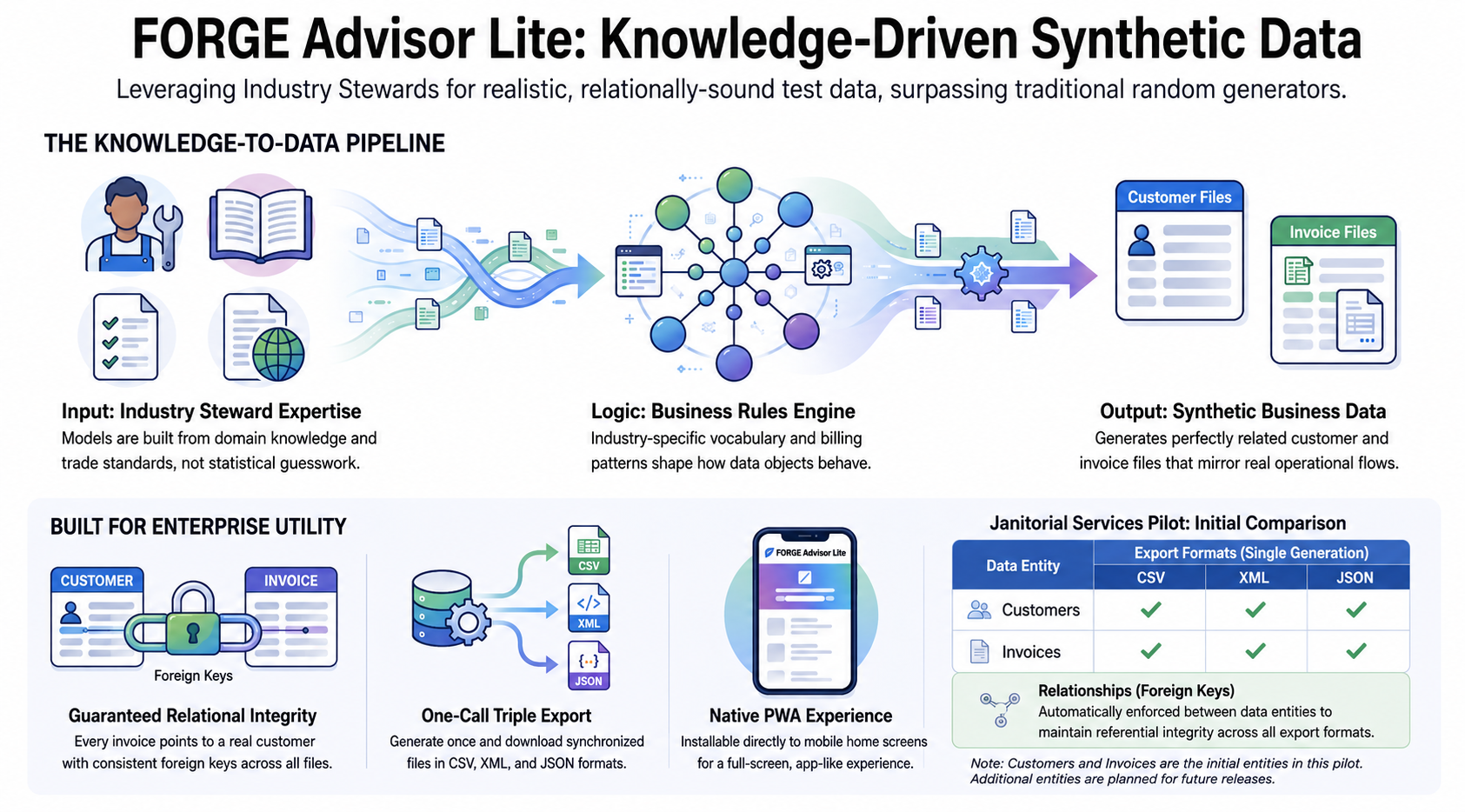
AI-generated visual summary (Google NotebookLM), reviewed and approved after two earlier revisions corrected factual errors in the export-format and entity-model panels.
The problem. Anyone who has tested software knows the drill: you need customers, you need invoices, you need enough of them, related to each other in ways that actually make sense, before you can trust a system works. Most synthetic-data tools produce isolated, random-looking records, a customer with no invoices, an invoice for a customer that doesn't exist. FORGE Advisor Lite exists to fix that specific, unglamorous, very real problem.
What it actually is. A small web application, built in a single weekend, that generates realistic synthetic test data, currently Customers and Invoices, for a business in whatever industry you tell it. Every invoice correctly points to a real customer, and industry-specific segments (in the first steward's case, vacation-rental accounts, billed differently and more often) are handled consistently across every export. It exports CSV, XML, and JSON from a single generation, no re-running the underlying AI call per format, since that would risk the files disagreeing with each other. It's also installable: open it in Chrome on Android, and the browser offers to add it to the home screen, launching full-screen, no address bar, indistinguishable at a glance from a native app.
The idea underneath it: Industry Stewards. Rather than generating random records, FORGE Advisor Lite grounds every dataset in an Industry Steward, a structured model of how a specific kind of business actually operates, built from real domain knowledge rather than statistical guesswork. The first steward covers commercial janitorial services, drawing on published standards from the Building Service Contractors Association International, combined with direct input from a real business owner, an actual working steward, who runs a professional housekeeping company and is lending real operational knowledge to how the data gets modeled. Janitorial services was chosen deliberately: almost everyone understands the business already, yet it still contains real complexity worth modeling correctly, recurring contracts, per-visit billing, a distinct vacation-rental segment. The underlying pipeline, in plain terms: Business Vocabulary feeds Business Rules, which shape Business Objects, connected by Relationships, producing a Synthetic Business, exported as CSV, XML, or JSON.
Why this matters beyond one weekend. This steward model is meant to be the foundation of a larger platform, FORGE Agent, an AI-driven data certification and marketplace tool that scores datasets across dimensions like quality, compliance, and governance. An AI certification engine can't invent, on its own, what "compliant" or "high-quality" means for a given industry, a real domain expert has to define that first. The janitorial steward being built right now is the first real instance of exactly the mechanism the whole certification platform will eventually depend on, for every industry it covers. There's a second layer too: a steward who actually runs a business notices when something in their industry shifts, often before any standards body gets around to publishing it, making the steward network less a static reference library and more a live sensing mechanism for industry change.
Staying honest about scope. This project draws a clear, deliberate line between what's real today and what's aspirational. Today: one steward, one industry, two entity types, three export formats, a real deployed URL, a real installable app. Tomorrow: more stewards across more industries, healthcare, construction, retail, and others, each eventually with its own steward relationship the way janitorial services has one now. Every "coming soon" is phrased as a direction, not a promise, and every "today" claim is something a visitor can actually go verify by opening the app.
The build itself. Real weekend, real friction: an Azure region with zero compute quota until a different region was tried, a PWA install prompt that silently refused to appear until a service-worker scope bug was traced and fixed, a file-format caching inconsistency flagged honestly and deliberately left for later rather than chased against the clock. None of that is a dramatic story. It's the actual texture of building something real in a weekend, which is more credible than a project that claims everything went according to plan.
About the Builder
Paula DiTallo is the Founder and Innovator at Bauhaus Technology and Graphic Holdings LLC, a consulting and product development firm focused on data strategy, monetization, and enterprise data management. Paula is the author of Security Without Accountability: The LAG Framework for Web 3.0 Governance, Algorithmic Infrastructures and the Temporal Reconfiguration of Accountability in Digital Governance, Forging Data into Value: The FORGE Model for Data Productization in Mid-Market Firms, and The Future of IT Leadership: The Rise of the Fractional CXO. Paula brings deep expertise in data governance, product design, and enterprise architecture to the FORGE project.